In part 02 we learned to speak. Today we learn
what the words mean. Every value in a Rust program has a type — a
contract, written down at compile time, describing exactly what the value is
and what you may do to it. 5 is a number. "5" is text. Mixing them up is
not a bug you find at 2 AM in production; it's an error the compiler shows you
while you're still typing, coffee in hand, dignity intact.
That's the whole philosophy of this article: in Rust, types are not paperwork. They're the guard rails. Let's walk the whole fence.
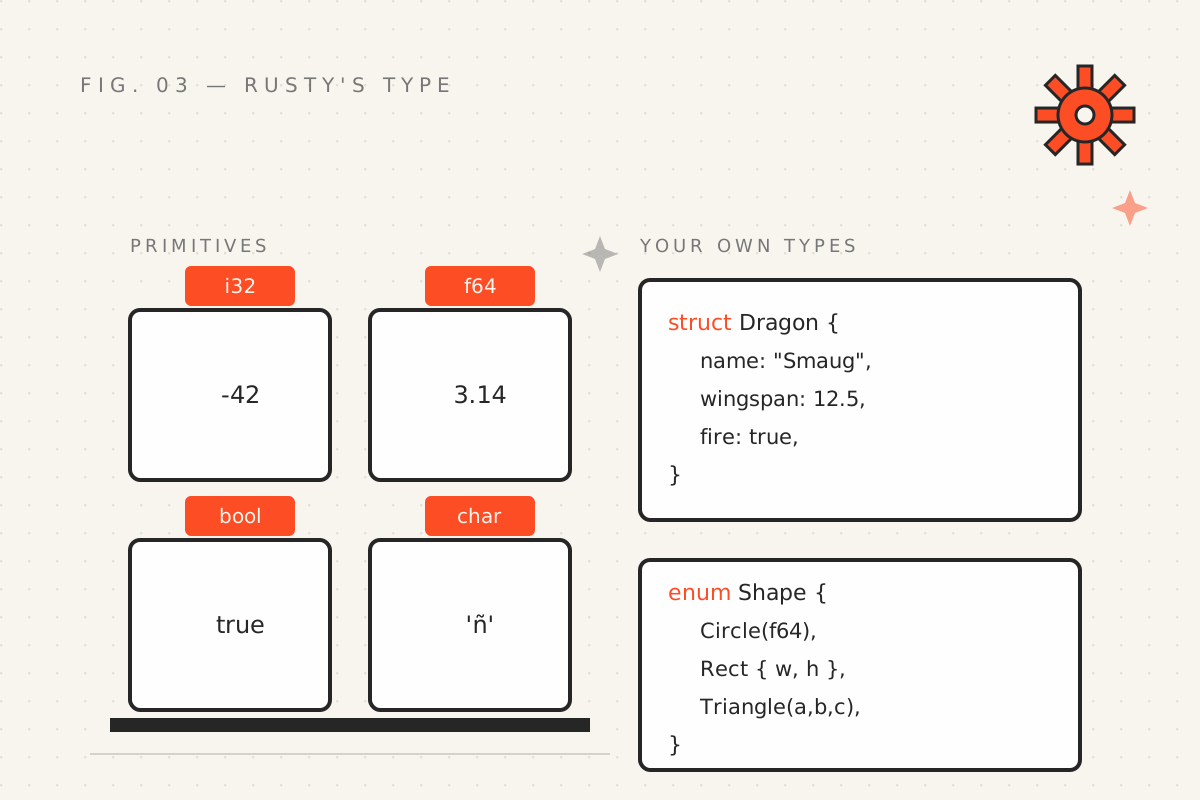
Variables: let, mut, and the art of shadowing
Rust variables are immutable by default. You declare with let, and the
binding is frozen unless you ask for a changeable one with mut:
fn main() {
    let hp = 100;        // immutable: hp = 95 would be a compile error
    let mut mana = 50;   // mutable: free to change
    mana = 42;

    println!("hp = {hp}, mana = {mana}");
}
Output:
hp = 100, mana = 42Why freeze things by default? Because most bugs are things changing that
shouldn't have. Immutability makes the compiler your witness: if a value can
change, you wrote mut, so you always know where to look. It's the set -u
of part 11 of the bash course, but built into
the language's spine.
Shadowing — declare it again, fresh
You can redeclare the same name with a new let. The new binding shadows
the old one from that point on:
fn main() {
    let spaces = "   ";      // a &str — three characters
    let spaces = spaces.len(); // a usize — the number 3
    println!("spaces = {spaces}");
}
Output:
spaces = 3Note what shadowing is not: it's not mut. With mut, the same box changes
contents — and its type can never change. With shadowing, you get a brand
new box with the same name, which may even hold a different type (above:
text became a number). Handy for conversions mid-function without inventing
names like spaces_str, spaces_num, spaces_final_v2.
Type annotations and inference
You usually don't write the type — the compiler infers it:
let x = 5;          // compiler: "integer. I'll pick i32."
let y = 2.5;        // "float. f64."
let flag = true;    // "bool."
let letter = 'z';   // "char."
But inference isn't psychic. When a value could legally be several types, you annotate with a colon:
let guess: u32 = "42".parse().expect("not a number");
//                   ^ parse could give u8, i16, u64... you must choose
Rule of thumb: let inference do the local work; write annotations where the meaning would otherwise be ambiguous — function signatures, struct fields, global constants. (We'll hit all three.)
Integers — a number for every size of worry
Rust has 12 integer types, and their names are the documentation. Each is a signedness plus a bit width:
| Type | Range | Notes |
|---|---|---|
i8 / u8 |
−128..127 / 0..255 | 8 bits — a byte. u8 is what file I/O speaks |
i16 / u16 |
±~32 thousand / 0..65,535 | 16 bits — audio samples live here |
i32 / u32 |
± |
i32 is the default |
i64 / u64 |
±~9 quintillion | timestamps, big counters |
i128 / u128 |
absurdly large | cryptography, nerd flexes |
isize / usize |
pointer-sized (64-bit on most machines) | indexing and memory math |
i= signed (can be negative),u= unsigned (zero and up only). The number is bits, so au8holds 2⁸ = 256 different values.usizeis the type of array indices and.len()— it's as wide as a memory address on your platform. You'll meet it constantly.
let a: i32 = -42;
let b: u8 = 255;
let big = 1_000_000_i64;  // underscores are free readability
let hex = 0xff;           // 255
let oct = 0o77;           // 63
let bin = 0b1010_1010;    // 170
let byte = b'A';          // 65u8 — a byte literal
println!("{a} {b} {big} {hex} {oct} {bin} {byte}");
Output:
-42 255 1000000 255 63 170 65The overflow story (this is the good part)
What happens when a u8 holding 255 gets +1? In C, undefined behavior. In
many languages, silent wrapping. Rust does something characteristically
honest:
- Debug builds (
cargo run): panic. Your program stops dead and tells you. Loudly. In the console. At the exact line. - Release builds (
cargo run --release): it wraps — two's complement — 255 + 1 becomes 0. The fast path is quiet, so the loud path exists to warn you before you ship.
And if wrapping is genuinely what you want, you say so, in words:
let x: u8 = 255;
// x + 1;                 // panics in debug
let _ = x.wrapping_add(1);   // 0  — on purpose
let _ = x.saturating_add(1); // 255 — clamps at the ceiling
let _ = x.checked_add(1);    // None — an Option that admits it overflowed
The language refuses to guess. You choose the behavior; the code states it.
Floats — precise enough, and honest about it
Two types: f32 (single precision) and f64 (double precision, the
default). They follow IEEE-754, the same standard as everyone else, which
means they're approximations:
let x = 2.0;      // f64
let y: f32 = 3.0; // f32

println!("{}", 0.1 + 0.2);          // 0.30000000000000004 — hello, old friend
println!("{}", 0.1 + 0.2 == 0.3);   // false — never == floats directly
println!("{}", (0.1 + 0.2 - 0.3).abs() < 1e-10); // true — compare with a tolerance
Output:
0.30000000000000004
false
true
Three house rules: don't mix f32 and f64 in one expression (the compiler
won't allow it silently), don't use == on computed floats (compare with a
tolerance), and for money use integer cents. Rust won't fix floating point —
nobody can — but it won't let you mix precisions by accident.
One more resident of number-town: division behaves by type. 7 / 2 with
two integers is 3 (truncated). 7.0 / 2.0 is 3.5. The types decide the
operation, not the other way around.
bool — the two-state switch
let t = true;
let f: bool = false;

println!("{}, {}", t, !f);        // true, true
// if t { ... }                    // bool, and ONLY bool, goes in an if
if in Rust takes a bool and nothing else — no if 1, no truthy strings,
no "empty list is false". If you've been burned by a language where 0 == false was somehow true, this is the truce you've been waiting for.
char — one honest Unicode letter
A char is a single Unicode scalar value, four bytes wide, in single
quotes (double quotes are strings):
let c = 'z';
let heart = '❤';
let cat = '🐱';

println!("{} {} {}", c, heart, cat);
Output:
z ❤ 🐱Four bytes means it can hold any Unicode scalar — emoji included — with no encoding surprises. (A full string is UTF-8 in memory, so a string's length in bytes and its count of characters can differ — a rabbit hole for the strings chapter.)
Tuples — the carry-all bag
A tuple glues a fixed number of values, possibly of different types, into one thing:
fn main() {
    let item: (&str, f64, u32) = ("coffee", 3.50, 2); // name, price, quantity

    println!("{}", item.0);        // access by index: coffee
    println!("{}", item.1 * item.2 as f64); // 7.0

    let (name, price, qty) = item; // destructuring — unpack in one line
    println!("{name} x{qty} = {}", price * qty as f64);
}
Output:
coffee
7
coffee x2 = 7
Destructuring is the payoff: one value comes out of the function, unpacks at
the destination, no temp variables. The empty tuple () — "unit" — is
Rust's "nothing", the type of a function that returns nothing. Every
expression in Rust has a type, even the ones that mean "I have nothing to
give you."
Arrays — same type, fixed size, lives on the stack
An array holds N values of one type, and N is part of the type itself:
fn main() {
    let dice = [1, 2, 3, 4, 5, 6];      // [i32; 6] — the 6 is IN the type
    let zeros = [0u8; 512];             // 512 zeros, one line

    println!("{} {} {}", dice.len(), dice[0], zeros.len());
    // dice[9];                          // panics: index out of bounds — checked, always
}
Output:
6 1 512Two things worth underlining. First, out-of-bounds indexing panics — Rust
checks every array access at runtime instead of letting you read garbage
memory. Second, because the length is part of the type, arrays can't grow.
For "a list I'll add things to", you want Vec<T> — a later chapter. Arrays
are for when the size is known and fixed: a die, RGB pixels, lookup tables.
Constants — known at compile time, forever
const looks like let but plays a different sport. Three rules make it
distinct:
const MAX_PLAYERS: u32 = 4;              // 1. type is REQUIRED
const SECONDS_IN_HOUR: u32 = 60 * 60;    // 2. computed at COMPILE time
const WELCOME: &str = "hello, player";   // 3. UPPER_SNAKE_CASE by convention

fn main() {
    println!("{WELCOME} — max {MAX_PLAYERS}, hour = {SECONDS_IN_HOUR}s");
}
Output:
hello, player — max 4, hour = 3600s- The type must be written out — no inference.
- The value must be computable at compile time: literals, arithmetic, other constants. No function calls that need to run, no heap.
- Constants can live at any scope, including top-level, outside any function — because they're inlined wherever used, not stored anywhere.
How is that different from an immutable let? let x = 5; creates a
binding at runtime; const MAX: u32 = 5; is more like a note the compiler
substitutes everywhere you wrote it. Use const for magic numbers and fixed
configuration — anything where changing the value means recompiling anyway.
There's also
static—static APP_NAME: &str = "boring";— which is a constant with a fixed memory address for the program's whole life. Reach forconstfirst; you'll meetstaticagain with globals andlazy_static.
Structs — build your own type, part 1
Primitives describe numbers and letters. Real programs traffic in things: users, invoices, dragons. A struct bundles related values into one named type:
#[derive(Debug)] // asks the compiler to auto-generate the printing trait from part 02
struct Dragon {
    name: String,
    wingspan: f64,   // meters
    fire: bool,
}

fn main() {
    let mut smaug = Dragon {
        name: String::from("Smaug"),
        wingspan: 12.5,
        fire: true,
    };

    smaug.wingspan = 13.0;                  // mutate one field (needs the whole dragon to be mut)

    let smaug2 = Dragon {                   // struct update syntax: clone the rest
        wingspan: 15.0,
        ..smaug
    };

    println!("{:?}", smaug2);
}
Output:
Dragon { name: "Smaug", wingspan: 15.0, fire: true }Field access is thing.field, mutation needs the whole struct to be mut,
and ..base copies the remaining fields from another instance. The
#[derive(Debug)] line is the trick from part 02 that makes {:?} printing
free.
Structs come in three flavors, and the other two are just… terser:
struct Point(f64, f64);   // tuple struct — fields have no names
struct Anchor;            // unit struct — carries no data, is itself the value

fn main() {
    let origin = Point(0.0, 0.0);
    println!("x = {}", origin.0); // access by index, like a tuple
}
Output:
x = 0Tuple structs are great for "a thing that is fundamentally one value with a
stronger identity" — a Meters(f64) is not interchangeable with a
Seconds(f64), and the compiler now enforces that. (This trick is called a
newtype, and it's free domain modeling.)
Methods — teaching the struct to do things
Types get behavior through impl blocks. Functions taking Self as their
first parameter are methods; ones without it are associated functions
(your constructors live here):
struct Dragon {
    name: String,
    fire: bool,
}

impl Dragon {
    // associated function — no self — called as Dragon::hatch()
    fn hatch(name: &str, fire: bool) -> Dragon {
        Dragon { name: name.to_string(), fire }
    }

    // method — borrows self for reading (&self)
    fn describe(&self) -> String {
        match self.fire {
            true  => format!("{} breathes fire", self.name),
            false => format!("{} is disappointingly tame", self.name),
        }
    }

    // method — borrows self for mutation (&mut self)
    fn enchant(&mut self) {
        self.fire = true;
    }
}

fn main() {
    let mut d = Dragon::hatch("Puff", false);
    println!("{}", d.describe());
    d.enchant();
    println!("{}", d.describe());
}
Output:
Puff is disappointingly tame
Puff breathes fire
The three flavors of self are a preview of part 05 (ownership and
borrowing) — for now: &self to read, &mut self to change, self to
consume. Dragon::hatch(...) with the double colon is how you call something
on the type itself rather than an instance.
Enums — build your own type, part 2 (the famous one)
Where a struct says "this AND this AND this", an enum says "this OR this OR this" — exactly one variant at a time. And Rust's variants can carry data:
enum Shape {
    Circle(f64),                       // just a radius
    Rectangle { w: f64, h: f64 },      // named fields, like a struct
    Triangle(f64, f64, f64),           // three sides
}

fn area(s: &Shape) -> f64 {
    match s {                          // match = "which variant is this?"
        Shape::Circle(r) => std::f64::consts::PI * r * r,
        Shape::Rectangle { w, h } => w * h,
        Shape::Triangle(a, b, c) => {
            let s = (a + b + c) / 2.0; // Heron, for the curious
            (s * (s - a) * (s - b) * (s - c)).sqrt()
        }
    }
}

fn main() {
    let shapes = [Shape::Circle(1.0), Shape::Rectangle { w: 2.0, h: 3.0 }];
    for s in &shapes {
        println!("{:.2}", area(s));
    }
}
Output:
3.14
6.00
Two powers compound here. match must handle every variant — add a
Square variant tomorrow and every match in the codebase that forgot it
becomes a compile error, not a support ticket. And variants hold whatever you
put in them: one value, named fields, or nothing.
This is the mechanism behind Rust's most famous decision. Other languages
express "a value that might not exist" with null — a value that is secretly
every type and no type, which Tony Hoare (who invented it) famously called his
"billion-dollar mistake". Rust has no null. It has an enum:
enum Option<T> {
    Some(T),   // there IS a value, and it's a T
    None,      // there is no value
}
The compiler forces you to handle None before you can touch the value
inside:
let maybe: Option<i32> = Some(42);
// println!("{}", maybe + 1);      // COMPILE ERROR: can't add to an Option
println!("{}", maybe.unwrap_or(0) + 1); // 43 — you must choose a default
"Can this be missing?" becomes part of the type. If a function returns
Option<User>, the ?-shaped question mark is written into the signature,
and forgetting it is impossible — the compiler checks every path. That's the
guard-rail philosophy again, applied to the single most common bug in the
industry.
Enums with match also make brilliant state machines, because illegal
states simply cannot be written:
enum Connection {
    Idle,
    Connecting { attempt: u32 },
    Open { sent: u64, received: u64 },
    Failed(String), // carries the error message with it
}
A Connection is always exactly one of those four. There is no value that
is somehow "connecting but also failed with no message" — that bug is
unrepresentable.
Casting — as, and its sharp edges
Rust never converts numeric types implicitly — i32 into u8 must be
explicit, with as:
let big: i32 = 300;
let small = big as u8;        // truncates: keeps low 8 bits
println!("{big} -> {small}"); // 300 -> 44 (300 - 256)
Output:
300 -> 44as is fast and dumb: it just reinterprets the bits, so out-of-range values
truncate or wrap silently. For conversions that can fail, prefer the honest
APIs — u32::try_from(big) returns an Option/Result admitting the risk —
and for structurally safe widening, From/Into (let x: i64 = 42.into();).
A later chapter covers the whole conversion zoo; for today, know that as
exists, and that its silence is a choice, not an accident.
The cheat sheet
let a = 42_i64;            // integer with suffix
let b: u8 = 255;           // annotated, will panic on overflow in debug
let c = 0xff;              // hex literal
let f = 2.5_f64;           // float (f64 default)
let t = true;              // bool — the ONLY thing if accepts
let ch = 'ñar';            // no wait, that's 3 chars; 'ñ' is one char
let tup = (1, "two", 3.0); // tuple: fixed, mixed types
let arr = [0u8; 4];        // array: fixed, one type, length in the type
const MAX: u32 = 100;      // compile-time, typed, UPPER_CASE
static NAME: &str = "ed";  // constant with a fixed address

struct Dragon { name: String, fire: bool }      // your type: AND
impl Dragon { fn new(name: &str) -> Self { ... } } // its behavior
enum Maybe { Some(i32), None }                  // your type: OR (exactly one)
type Meters = f64;                              // alias: a new name, same type
(Yes, the ch line was a trap — 'ñ' is a char, 'ñar' is a &str.
Single quotes for one, double quotes for many. The compiler said so before you
even ran it.)
Your quest
- Declare
let x = 5;then shadow it into a float and print both types using{:?}andstd::any::type_name— meet your first type inspector - Make a
u8overflow in a debug build and read the panic; then fix it three ways:wrapping_add,saturating_add,checked_add - Build a
Songstruct (title, artist, seconds) with asummary(&self)method; print three songs - Write an enum
Paymentwith variantsCash(f64),Card { last4: u16 }, andNone; write adescribefunction withmatchthat handles all three — then add a fourth variant and enjoy the compiler doing your code review - Replace a magic number in an old program with a
constand feel the future you saying thanks
Next: part 04 — control flow: if as an expression,
loop/while/for, and the full depth of match — including guards,
binding, and the ? operator's cousin. The types are the nouns; next we get
the verbs.
Filed under Learning Rust — part 03 of the series · Previous: Rusty's Hello World!