Fourteen parts ago, $ was a strange rune and Ctrl+C was a prayer. Today it's
the finale of the Wizardy of Bash bash crash
course, and there's nothing left to teach — only things to build. On the wall
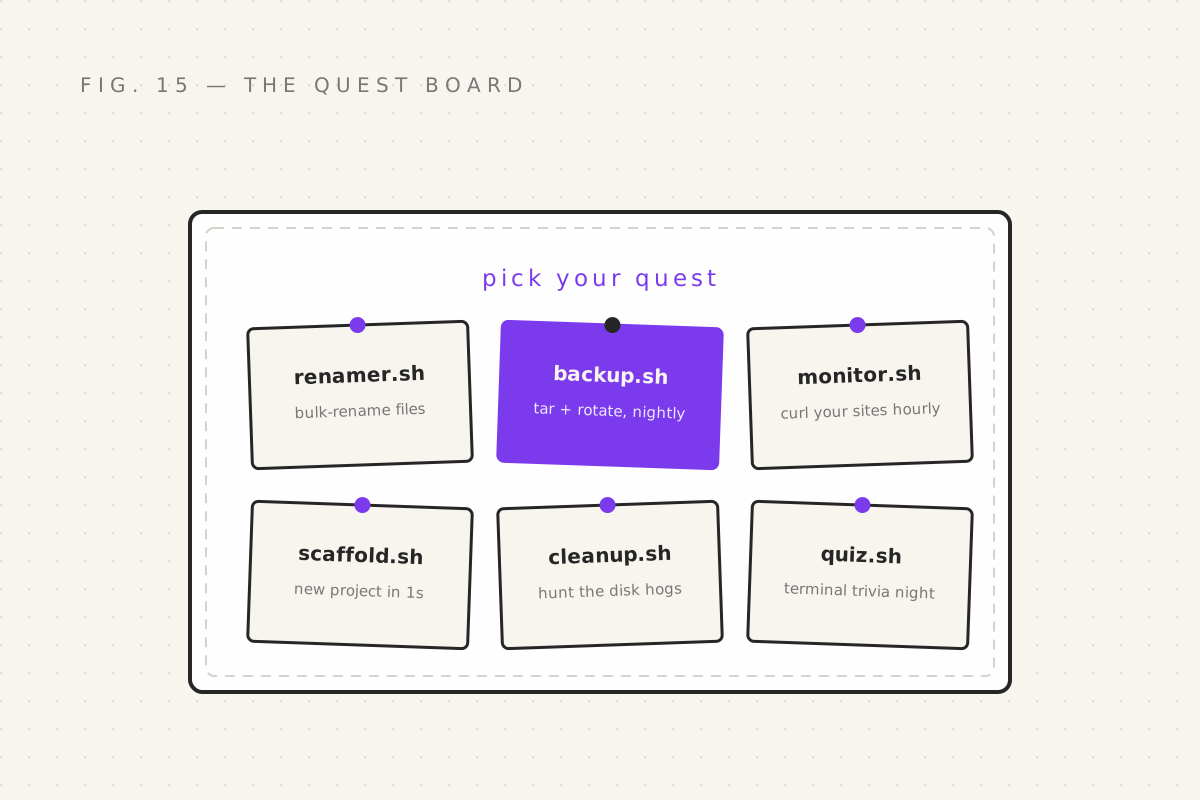
of the guild hall hangs the quest board. Six quests. Each one is a real,
working script, and each is deliberately assembled from a specific set of
parts — so finishing one tells you exactly what you've mastered, and
skipping one tells you what to reread.
Quest I: renamer.sh — the herder
Skills: loops (08), variables & quoting (06), command substitution (06), arithmetic. The classic first script, because the pain it cures is universal: 400 files with terrible names.
#!/usr/bin/env bash
# renamer.sh — rename every file matching a pattern to prefix-001, prefix-002...
# usage: ./renamer.sh "Screenshot_" "trip"
set -euo pipefail                                # the ward (11)

pattern="${1:?Usage: renamer.sh <pattern> <prefix>}"
prefix="${2:?Usage: renamer.sh <pattern> <prefix>}"

n=1
for f in "$pattern"*; do                         # glob with the pattern; quoted for safety
  [[ -f "$f" ]] || continue                      # skip directories (07)
  ext="${f##*.}"                                 # everything after the last dot (parameter expansion)
  new=$(printf '%s-%03d.%s' "$prefix" "$n" "$ext")
  mv -n -- "$f" "$new"                           # -n: never clobber an existing file
  echo "$f → $new"
  n=$((n + 1))
done
echo "Herd complete: $((n - 1)) files renamed."
Run it on sacrificial files first: mkdir practice && cd practice && touch "Screenshot_a b.png" "Screenshot_c.png" then
~/bin/renamer.sh "Screenshot_" trip. Note the space in that first filename —
that's the file that breaks unquoted scripts, and yours will eat it for
breakfast, because every variable is quoted and the ward is on.
Quest II: backup.sh — the vault
Skills: functions & arguments (09), tar, trap (11), cron (14). Part 09
sketched this; here's the full build with rotation — keep a week, then prune:
#!/usr/bin/env bash
# backup.sh — dated, rotating backups of a folder
# usage: ./backup.sh <source> [dest] [keep]
set -euo pipefail

src="${1:?Usage: backup.sh <source> [dest] [keep]}"
dest="${2:-$HOME/backups}"
keep="${3:-7}"

[[ -d "$src" ]] || { echo "No such folder: $src" >&2; exit 1; }   # stderr for complaints (05)
mkdir -p "$dest"

stamp=$(date +%Y-%m-%d_%H%M)                     # minute-precision: no same-day collisions
archive="$dest/backup-$stamp.tar.gz"

tar -czf "$archive" "$src"
echo "✓ stored $archive ($(du -h "$archive" | cut -f1))"

# rotation: delete archives older than $keep days
find "$dest" -name 'backup-*.tar.gz' -mtime +"$keep" -print -delete   # (04: print, then delete)
echo "Rotation done. Kept the last $keep."
And the immortality step from part 14: crontab -e, then
30 2 * * * ~/bin/backup.sh ~/projects >> ~/backups/backup.log 2>&1. Your
data now backs itself up nightly while you dream. This is the script that
eventually saves your career; add the cron line the same evening.
Quest III: monitor.sh — the watchman
Skills: pipes (05), until (08), functions (09), trap (11), nohup (12).
Watch a website and cry out when it falls:
#!/usr/bin/env bash
# monitor.sh — check a URL on a loop; log status changes
# usage: ./monitor.sh <url> [interval-seconds]
set -uo pipefail                                  # no -e here: a failed curl IS the data

url="${1:?Usage: monitor.sh <url> [interval]}"
interval="${2:-60}"
log="$HOME/monitor-$(date +%Y-%m-%d).log"
was_up="unknown"

cleanup() { echo "Watch ended. Log: $log" >&2; }
trap cleanup EXIT                                 # (11: tidy, whatever happens)

while true; do
  if code=$(curl -s -o /dev/null -w '%{http_code}' --max-time 10 "$url"); then
    status="up ($code)"
  else
    status="DOWN"
  fi

  if [[ "$status" != "$was_up" ]]; then           # only speak on CHANGES: no spam
    echo "$(date '+%H:%M:%S') $url $status" | tee -a "$log"   # (05: screen AND file)
    was_up="$status"
  fi
  sleep "$interval"
done
Run it with part 12's survival spell: nohup ~/bin/monitor.sh https://yoursite.com 60 > /dev/null 2>&1 & — it outlives your terminal and
logs every flip between up and down. Point it at something you love. It will
eventually go DOWN, and you'll be glad something was watching.
Quest IV: scaffold.sh — the summoner
Skills: functions (09), heredocs, case (07), defaults (06). New
projects deserve rituals, not copy-paste archaeology:
#!/usr/bin/env bash
# scaffold.sh — summon a ready-to-work project folder
# usage: ./scaffold.sh <name> [python|node]
set -euo pipefail

name="${1:?Usage: scaffold.sh <name> [python|node]}"
type="${2:-python}"

mkdir -p "$name"
cd "$name"
mkdir -p src tests

case "$type" in                                   # (07: the readable fork)
  python)
    cat > README.md <<EOF                         # heredoc: a multi-line spell, no echo chorus
# $name
Created $(date +%Y-%m-%d). Rituals pending.
EOF
    touch src/main.py tests/test_main.py requirements.txt
    ;;
  node)
    cat > package.json <<EOF
{ "name": "$name", "version": "0.1.0", "scripts": { "test": "echo no tests yet" } }
EOF
    mkdir -p lib
    ;;
  *)
    echo "Unknown type: $type (want python or node)" >&2
    exit 1
    ;;
esac

git init -q
echo "✓ $name summoned ($type). Enter: cd $name"
The heredoc (<<EOF … EOF) is the new rune here: everything until the
terminator is written verbatim — with variables expanded — into the file.
It's the polite way to write templates. Your five-minute setup is now one
command, forever.
Quest V: cleanup.sh — the hunter of hogs
Skills: find (04), awk (10), set -u (11), interactive confirmation.
A disk janitor that asks before touching anything:
#!/usr/bin/env bash
# cleanup.sh — find big, old files; delete only with consent
set -u                                            # no -e: we WANT to survive findings

dir="${1:-.}"
min_age="${2:-30}"                                # days untouched
min_size="${3:-50M}"

echo "Hunting in $dir: files > $min_size, untouched $min_age+ days"
find "$dir" -type f -size +"$min_size" -mtime +"$min_age" -print0 |
while IFS= read -r -d '' f; do                    # -print0/-d '': survives ALL filenames (spaces! newlines!)
  size=$(du -h "$f" | cut -f1)
  read -p "Delete $size  $f? [y/N] " answer
  [[ "$answer" == "y" ]] && rm -- "$f" || echo "spared: $f"
done
echo "Hunt complete."
The read -p confirmation makes it safe; the -print0/-d '' pairing makes
it bulletproof — the professional answer to "but what if a file has a
newline in its name" (someone's does). This is part 04's hunters, fully
domesticated.
Quest VI: quiz.sh — the final exam
Skills: arrays, read, arithmetic, exit codes — everything, plus one new
rune. A tiny quiz game. The course's last new syntax is arrays, and you get
it as a reward:
#!/usr/bin/env bash
# quiz.sh — terminal trivia, self-administered graduation
set -u

questions=(
  "Which stream is the drunk friend shouting from the kitchen? (stdout/stderr)"
  "What exit code means success? (a number)"
  "Which key finishes your sentences? (a key)"
  "The four-letter ward? (a set command)"
)
answers=( "stderr" "0" "tab" "set -euo pipefail" )

score=0
for i in "${!questions[@]}"; do                   # arrays: "${!arr}" = the indexes
  read -p "$(echo "${questions[$i]}) ")" ans
  if [[ "${ans,,}" == "${answers[$i],,}" ]]; then   # ${var,,}: lowercase (bash 4+)
    echo "✓ correct"; score=$((score + 1))
  else
    echo "✗ it was: ${answers[$i]}"
  fi
done

echo "Score: $score/${#questions[@]}"             # ${#arr}: the count, like $# (06)
[[ $score -eq ${#questions[@]} ]] && echo "GRADUATE. The guild banner is yours." \
                                  || echo "The guild welcomes retry-takers. (14 parts await.)"
If you can read every line of that script without looking anything up — the
array indexing, ${var,,}, $(( )), the &&/|| chain, the exit-code
humour at the end — you didn't take a quiz. You took a final exam, and the
score doesn't matter, because comprehension is the banner.
After the quests
Ship all six into ~/bin/ (add ~/bin to your PATH — part 06, full
circle), chmod +x each, and they're spells you cast from anywhere. Put them
in your dotfiles repo (part 13) and every future machine inherits your guild
achievements.
That's the whole course: prompt to pipelines, boxes to background jobs, wards to quests. Fifteen parts, one honestly under-rated truth — the shell was the real magic all along, and now it's yours. Go automate something you hate.
Filed under Wizardy of Bash — part 15 of 15 · Previous: The Wider Realm · Next: none — you are the next part.